


ICOM ID-5200A
ICOM ID-5200A
ICOM ID-5200A 2mt & 70cm Amateur bands with D-star
Introductory special - IN STOCK NOW
ICOM promo for first 30 sold. This will not last long.
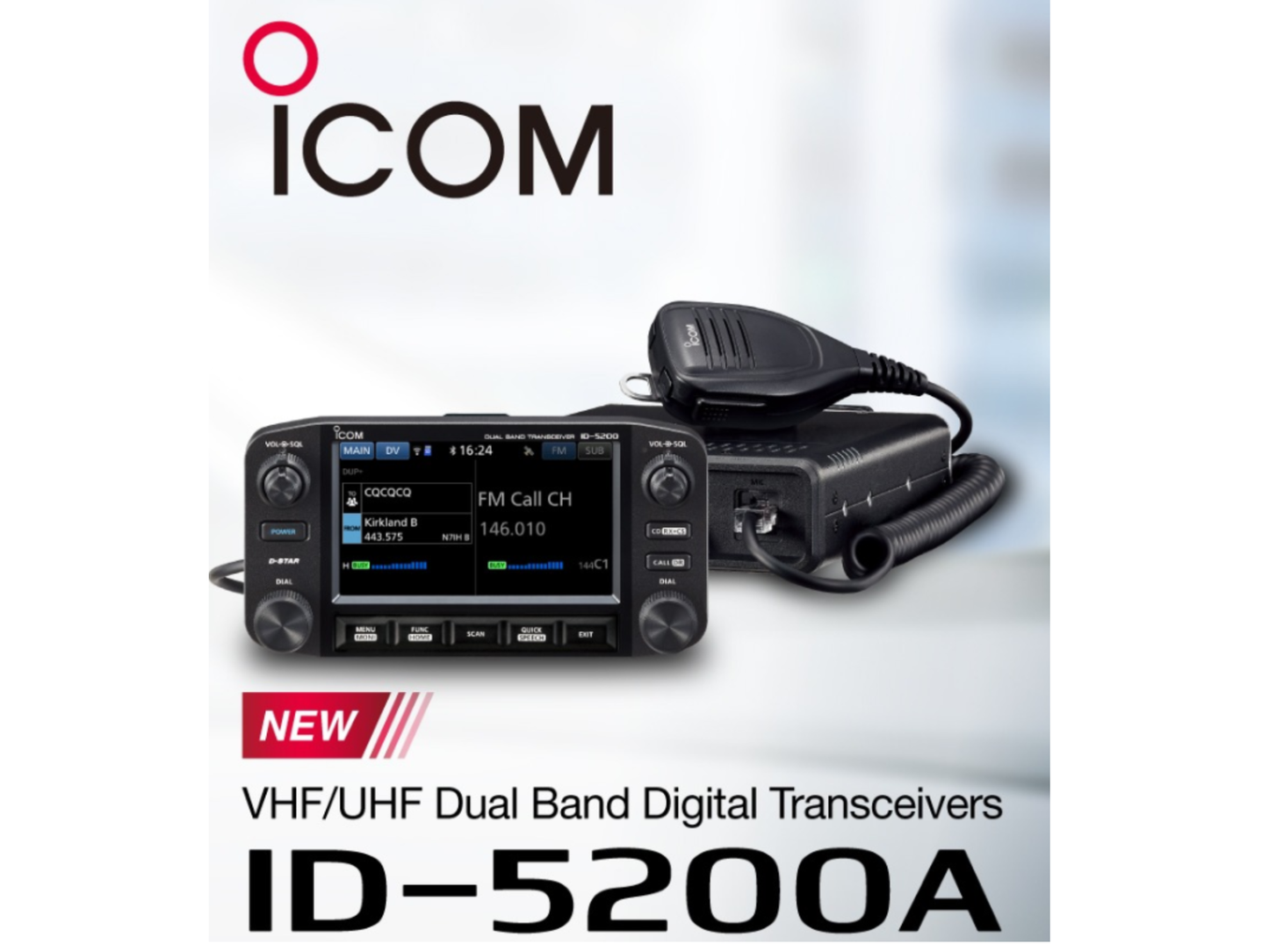
Icom Inc. proudly announces the launch of the ID-5200A/E, 144/430 MHz dual-band transceiver for amateur radio, in summer 2026.
The ID-5200A/E is a mobile transceiver equipped with a large 4.3-inch color touchscreen. The radio features a waterfall display, allowing users to easily see signal activity and band conditions. It features independent dials, volume knobs, and squelch knobs for the A and B bands, positioned on the left and right sides respectively, and includes dedicated physical buttons for frequently used menus and functions, enabling smooth and intuitive operation.
The ID-5200A/E supports enhanced D-STAR functions such as Terminal Mode, Access Point Mode, DV Repeater Monitor, and image transmission and reception. It also supports Wi-Fi connectivity (with built in access point capability), allowing comfortable use of Terminal and Access Point modes via an Internet connection. Support for APRS (Automatic Packet Reporting System) is planned through a future firmware update.
The radio supports true dual-band simultaneous reception, including FM/FM, FM/DV, and DV/DV. Users can monitor two D-STAR repeaters or listen to another repeater while in QSO. It also supports V/V, U/U, and V/U dual receive, including Airband.
In addition, several optional mounting brackets are available, including in vehicle mounts, docking brackets, and desktop stands, allowing flexible installation to suit various operating environments.
Main Features:
- A Large Touchscreen Color display with Excellent High Visibility
- Independent Dual‑band Dials for Superior Operability
- The First Mobile Transceiver to Feature Waterfall Display
- Memory Scope Function
- Enhanced D‑STAR Functionality, Including Terminal Mode and Access Point Mode
- Supports APRS* (Automatic Packet Reporting System)
- Connectivity for Smartphone and PC with Wi-Fi®/Bluetooth®
- Supports Dualwatch including DV/DV
- Flexible Mounting Options in the Vehicle
*Planned for support in a future firmware update
Couldn't load pickup availability
Share


There’s nothing quite like a box of new kit arriving. While a new radio doesn’t have that ‘new car smell’, there is the thrill of pulling out the hardware in plastic bags, intricately designed cardboard packaging, associated bits and pieces and manuals that make it a special moment for nerds and geeks alike. It’s also nice to see a screen without fingerprints for the last time in the unit’s life.
Today my Icom ID-5200 arrived from G and C Communications in Melbourne, as did a bag of swag from Icom Australia (for being one of the first 30 warranty registrants). Thanks to both for great service.
To give some context to my thoughts, it’s best if I first explain what I have been using on 2m and 70 cm to date. The new radio is for the home base. To date at home for 2/.7, I have been using an Icom IC-2730A Black. D-Star at home has been via the ID-52A Plus and a HS9AWO hotspot. Both have worked well but when I saw the ID-5200 announced in 2025, I knew that would be the machine to complete my shack. The IC-2730A Black will go to my car and the ID-52A Plus will be my carry radio.
My first impression? It’s a big ID-52A Plus. I remember back in 2010 when the iPad came out. Critics said, it’s just a big iPhone. To which I said “great”. Same here. It’s a big ID-52A Plus with loads more features and transmitting power. And that’s great, regally great. I think the ID-52 A Plus is a great radio. Even better, much of the look and feel in terms of menus, layouts, functionality and more are pretty much the same.
I was able to get on air fairly quickly, tuning both VFO’s into local aviation. The user interface was intuitive and the sound output was good. I then updated the firmware from what shipped to what was released last week. Again, this was a similar process to updating the ID-52A Plus.
But here’s the really cool thing. Icom has released CS-5200, it’s Windows software for its radios. Now, it looks like it was made for and hasn’t been updated since Windows 95, but it actually works, and well. Even better, from the CS-52A software, I could export my repeaters lists, channel lists and call channel lists to CSV files and then import them into my CS-5200 software. It uploaded immediately and everything just worked. That was very cool. Oh, and this was all done through USB-C from the PC to the unit. No special cable and drivers were required.
My only criticism of the ID-5200 is that the head unit is off on its own. There’s no way to secure the head unit to the radio or anything else out of the box. Coming soon are a desktop stand and bracket to join the head and base unit. It comes with a bracket that includes magnets to connect the head unit to a vehicle dashboard or wall. But it’s not very functional. However, I did work out that by installing the magnets, I could turn the radio base unit at 90 degrees and it would hold the head in place so I could use it on the shelf. There is a bracket coming around the new year that will enable me to secure the head unit to the base front on. But for now, it’s OK. And it ships with an insanely long cable to connect the head to the base. Again, I can live with that for now.
To add some context to the two pictures above, for the moment, I am using the microphone that came with IC-2730A, with all of the bells and whistles. The microphone that comes with the 5200 is the ‘no-frills’ version and I will get another shortly for the base.
So, all in all, first impressions are good. I have a bit to learn going through he many additional functions but 15 minutes after powering up, fiddling with software and rebooting, I was on the air, talking locally and globally through FM and D-Star. It’s a worthwhile addition to the shack. I’m happy.